Is New Construction Finally a Better Deal Than Buying an Existing Home in Northwest Indiana?
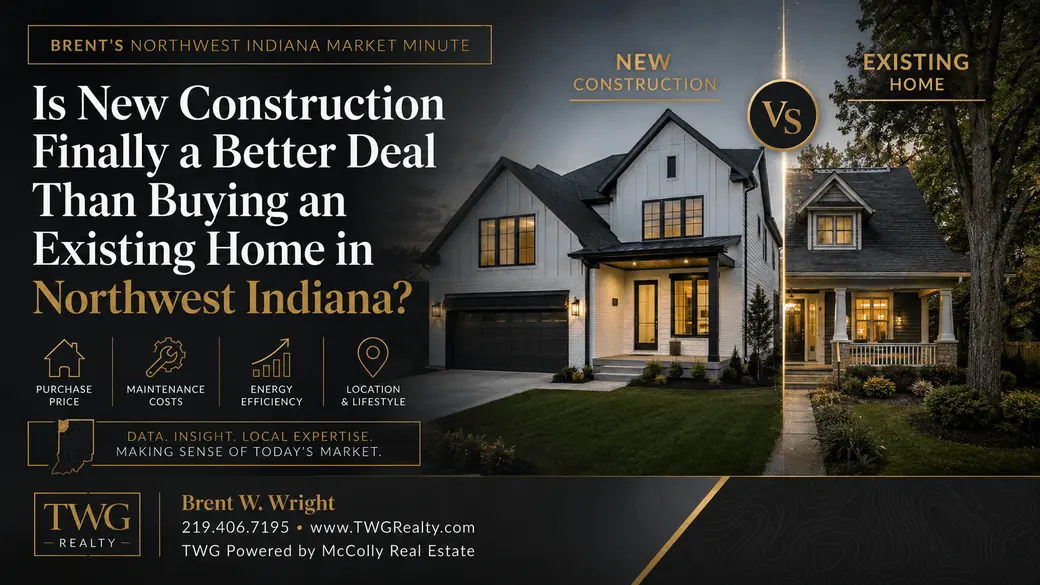
Is New Construction Finally a Better Deal Than Buying an Existing Home in Northwest Indiana?
For years, buyers often assumed one thing:
New construction costs more.
And on the surface, that makes sense.
Everything is new.
New roof.
New furnace.
New air conditioner.
New windows.
New appliances.
New finishes.
No previous owner ever decided purple carpet and sponge-painted bathroom walls were a good idea.
But in 2026, comparing new construction with an existing home isn't as simple as comparing list prices.
Northwest Indiana's New Construction Market Is Interesting
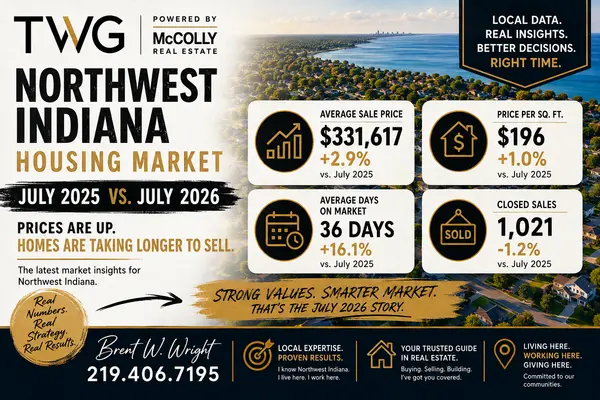
My July 2026 Northwest Indiana Market Minute showed:
New-construction closings fell from 106 to 99 year over year.
Average sale price increased from approximately $416,865 to $440,629.
Median pricing remained essentially flat around $400,000.
And the percentage of new homes selling within 30 days increased from 47.2% to 55.6%.
That's a fascinating combination.
The market isn't rejecting new construction.
It's sorting it.
Compare That With June
June told another interesting story.
New construction closings increased from 109 to 114.
Average days on market dropped from 91 days to 51 days year over year.
And the average sale-to-list ratio improved to approximately 99.58%.
Builders appear to be getting sharper with:
Product.
Pricing.
Timing.
And incentives.
Here's Where Buyers Make a Mistake
Imagine:
Existing home: $375,000
New home: $400,000
The obvious conclusion?
The existing house is $25,000 cheaper.
Maybe.
But what if the builder is offering:
Closing-cost assistance.
A mortgage-rate incentive.
Appliances.
Upgrades.
Or a price reduction.
Now look at the existing house.
It may need:
Roof.
HVAC.
Flooring.
Paint.
Windows.
Appliances.
Landscaping.
Suddenly that $25,000 difference isn't as straightforward.
Compare Effective Cost, Not Sticker Price
This is the key.
Don't ask:
“Which home is cheaper?”
Ask:
“Which home costs me less over the next five years while giving me the lifestyle I want?”
That's a much better comparison.
Existing Homes Have Advantages Too
New isn't automatically better.
Existing homes may offer:
Mature trees.
Larger lots.
Established neighborhoods.
Finished basements.
Fences.
Decks.
Pools.
Sheds.
Window coverings.
Landscaping.
And locations where vacant land simply isn't available anymore.
A 15-year-old house with a finished basement, fence, deck and mature landscaping might offer tremendous value.
Don't Forget What the New House DOESN'T Include
This one catches buyers.
The model home is gorgeous.
Then you buy the actual house.
Now add:
Blinds.
Fence.
Deck.
Patio.
Landscaping.
Irrigation.
Finished basement.
Garage shelving.
Appliances.
Suddenly your “brand-new house” has a pretty healthy after-closing shopping list.
Factor that into the comparison.
New Construction Wins on Predictability
One of the strongest arguments for new construction is predictable maintenance.
A brand-new roof shouldn't need replacement.
The furnace and air conditioning should have years of life ahead.
Appliances may have warranties.
Windows are new.
Major systems are new.
That can be very appealing for buyers who don't want surprise capital expenses.
Energy Efficiency Matters
Modern construction generally benefits from newer:
Building codes.
Insulation.
Windows.
HVAC equipment.
Air sealing.
And materials.
No, your utility bill isn't going to disappear.
The utility companies haven't decided to become charities yet.
But operating efficiency absolutely deserves a place in the comparison.
Location Can Make Existing Homes the Winner
You can't build new construction where no buildable land exists.
If you want a specific mature neighborhood or school district, an existing home may be the only option.
That's particularly true in established sections of places like Munster, Portage, Chesterton and Valparaiso.
Real estate remains about location.
A cheaper new house 25 minutes farther from where you actually want to live may not be the better deal.
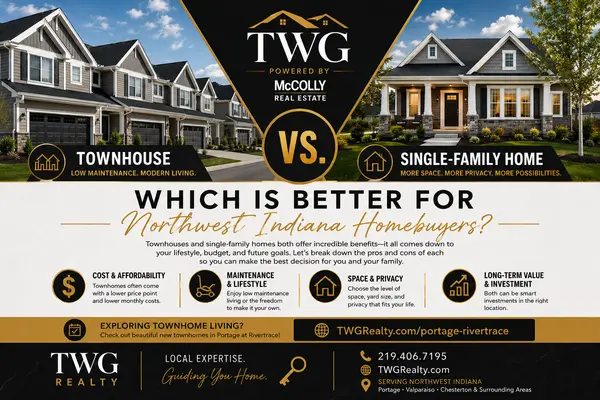
What About Townhomes and Villas?
This is another part of the new-construction discussion that's worth considering.
Many buyers can get newer construction and lower exterior maintenance by choosing an attached home.
Read my comparison:
Townhouse vs. Single-Family Home in Northwest Indiana
And if Portage interests you, take a look at:
Rivertrace new homes in Portage
Compare Everything Side by Side
Here's how I'd compare a new home with an existing home:
Purchase price.
Interest rate.
Builder or seller concessions.
Closing costs.
Property taxes.
Insurance.
Immediate repairs.
Five-year expected maintenance.
Appliances.
Improvements needed after closing.
Energy costs.
Lot.
Location.
Commute.
Then comes the one thing Excel can't calculate:
Which house do you actually want to live in?
The Brentified Bottom Line
I believe Northwest Indiana buyers should seriously compare new construction and existing homes rather than automatically assuming one is the better deal.
Sometimes builder incentives make the new home surprisingly competitive.
Sometimes an existing home comes with tens of thousands of dollars in improvements you would otherwise have to add yourself.
The best deal is the property that gives you the best combination of:
Price.
Payment.
Condition.
Location.
Future expenses.
And quality of life.
Sometimes that's brand new.
Sometimes it's the 25-year-old house with mature trees, a finished basement and a backyard you couldn't recreate for $100,000.
That's why we run the numbers.
You can start by searching all Northwest Indiana homes for sale, then compare new and existing options side by side.
Brent W. Wright
219.406.7195
TWG Powered by McColly Real Estate
www.TWGRealty.com
Categories
- All Blogs (91)
- affodability (1)
- Brent's Market Minute (9)
- Build Your Dream Home (4)
- Buyers (4)
- Buying & Selling Homes (16)
- buying a home (13)
- Cedar Lake IN (1)
- Cedar Lake Indiana Real Estate (1)
- Chesterton IN Real Estate (2)
- Crown Point IN (4)
- Crown Point Indiana Real Estate (1)
- First-Time Homebuyers (8)
- Golf Course Communities (1)
- Griffith Indiana Real Estate (1)
- Home Buying Tips (10)
- Home for sale (22)
- home values (1)
- Homes for Sale (4)
- Houses for sale (3)
- Housing Market Trends (9)
- illinois to indiana (1)
- Just Listed (2)
- Lake County Indiana Real Estate (2)
- Land & Acreage (1)
- LaPorte County Indiana Real Estate (2)
- Local Market Insighs (2)
- Lots & Land (1)
- Luxury Homes (1)
- Market Update (2)
- Mortgage & Interest Rate Insights (1)
- Munster Indiana (1)
- New Construction (6)
- Northwest Indiana Real Estate (35)
- Northwest Indiana Real Estate Market Updates (11)
- Portage IN (11)
- Portage IN Homes for Sale (6)
- Portage IN Real Estate (8)
- Portage Indiana Homes for Sale (5)
- Portage Indiana Real Estate (1)
- Porter County Indiana Real Estate (2)
- Porter County Real Estate (2)
- Real Estate (41)
- Real Estate Guides (9)
- Real Estate Listings (4)
- Relocation (2)
- RiverTrace Subdivision (4)
- Sellers (3)
- selling a home (3)
- St. John Indiana Real Estate (1)
- Townhomes (2)
- Valparaiso Homes for Sale (2)
- Valparaiso IN (5)
- Westville IN (1)
Recent Posts